Introduction to Domain-Driven Design
What is a Domain?
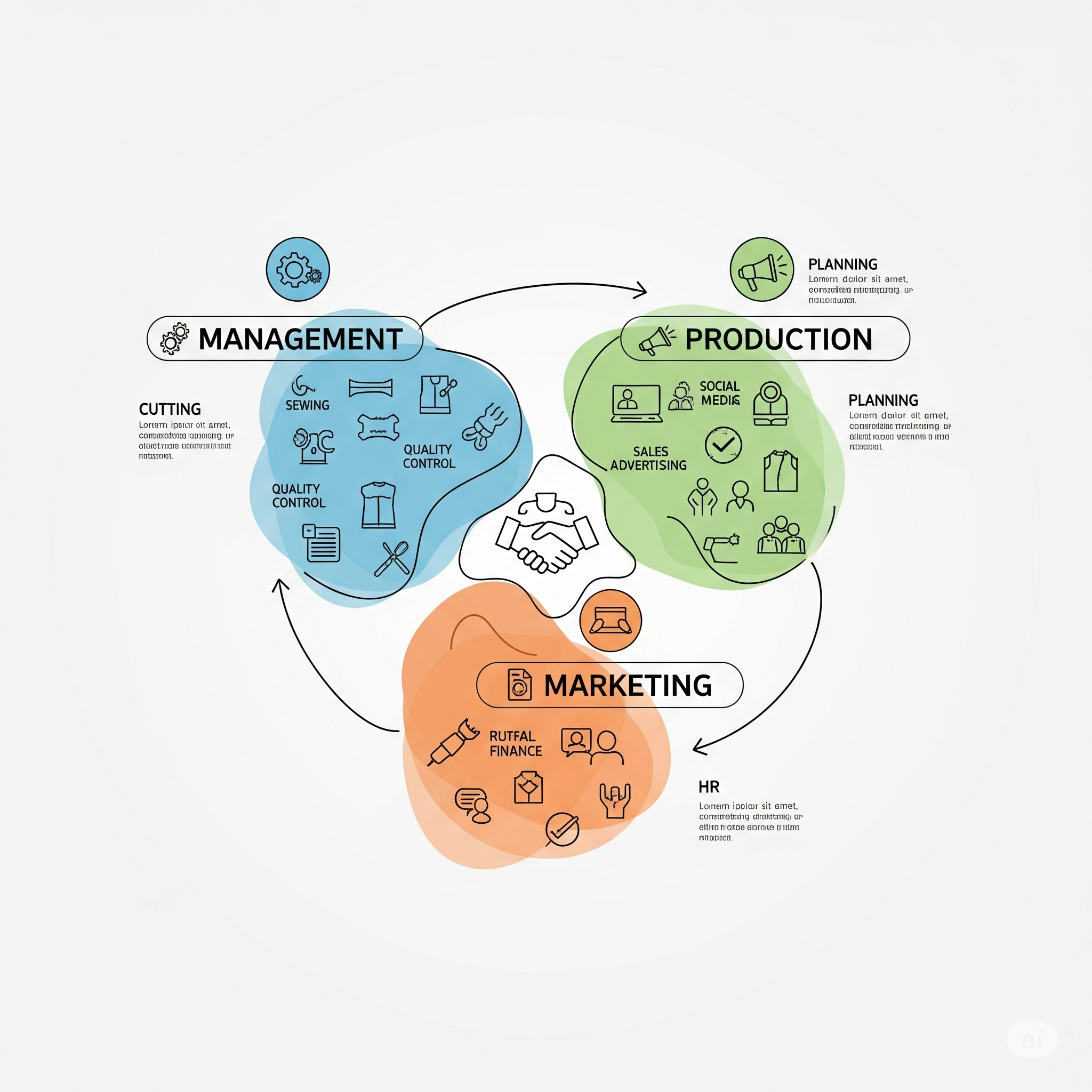
A "domain" is a broad area of knowledge, activity, or responsibility. It represents a specific field or sphere of influence that has its own set of functions, goals, and expertise.
Think of it as a department or a major division within a larger organization. For example, in a company, the "Finance" domain handles all money-related matters, while the "Marketing" domain is responsible for promoting the company's products or services. Each domain has a clear purpose and a distinct set of tasks.
The term "domain" is often used to:
- Categorize and Organize: It helps to break down a complex system or organization into smaller, more manageable parts. This makes it easier to understand how different areas function and how they relate to one another.
- Define Responsibilities: It clearly delineates what a team or individual is accountable for. For instance, in a clothing factory, the Production domain is responsible for manufacturing the garments, while the Sales and Marketing domain is responsible for selling them.
- Facilitate Specialization: It allows people to specialize and become experts in a particular area. A finance professional doesn't need to be an expert in sewing, and a pattern maker doesn't need to be an expert in accounting.
- Structure Systems: In fields like software development, a "domain" refers to the specific business area the software is designed for (e.g., the "e-commerce domain" or the "healthcare domain"). This helps developers model the real-world problem they are trying to solve.
Strategic and Tactical Patterns
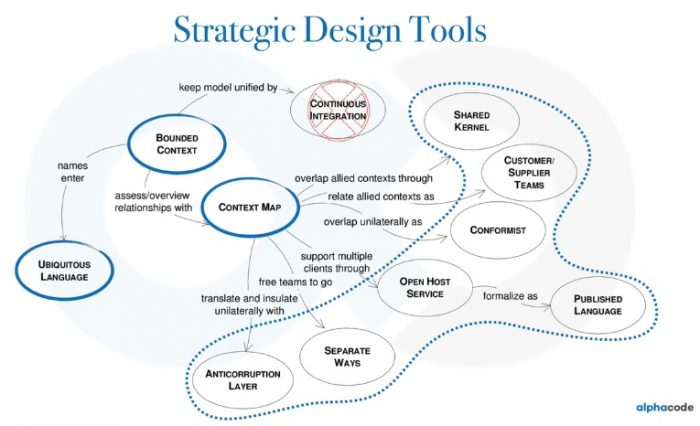
Strategic and tactical patterns in Domain-Driven Design (DDD) are essential components that help structure complex systems effectively. Strategic patterns provide a high-level view, helping to identify and organize different parts of the domain into bounded contexts, as well as defining how these parts interact with each other. This approach facilitates collaboration between teams and the management of system complexity. On the other hand, tactical patterns focus on the implementation details within each bounded context, addressing the modeling of elements such as entities, value objects, aggregates, and services. While strategic patterns guide the overall organization and structure of the system, tactical patterns ensure that the business logic and code architecture are aligned with the specific needs of the domain, allowing for a more robust and adaptable construction.
Strategic Patterns
-
Bounded Context:
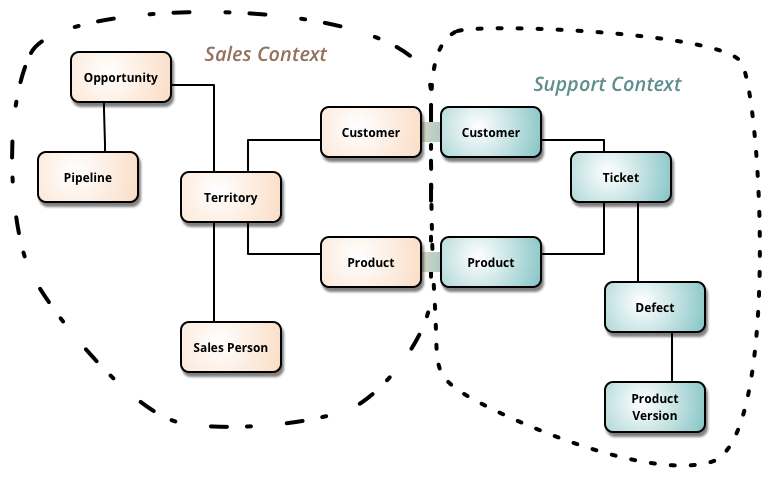
- A bounded context is a specific part of the domain where a particular model is applied. This pattern helps to divide a complex system into manageable parts, each with its own language and rules. The interaction between different bounded contexts must be clearly defined, avoiding confusion and model conflicts.
-
Domain Model:
- The domain model represents the business logic and structure of the system. It captures the fundamental rules and concepts of the domain, allowing teams to understand and work with the most important aspects of the business. A well-designed domain model is essential for the effectiveness of DDD.
-
Context Mapping:
- This pattern deals with the interaction between different bounded contexts. Context mapping helps to document and understand how contexts communicate, identifying the relationships and dependencies between them. This is crucial for ensuring that the integration between different parts of the system is done efficiently and smoothly.
-
Anti-Corruption Layer:
- The anti-corruption layer pattern is used to protect a bounded context from external influences that could corrupt its model. It serves as an intermediary layer that transforms communications and data from external systems, ensuring that the rules and integrity of the domain model are not compromised.
-
Subdomains:
- Subdomains are parts of the main domain that can be addressed independently. They help to identify specific areas of focus within the system, allowing teams to concentrate on solving specific problems. Subdomains can be classified as Core Domain, Supporting Subdomain, or Generic Subdomain, depending on their importance and complexity within the system.
-
System Design:
- This pattern involves defining the architecture and structure of the system, including the choice of technologies, frameworks, and communication patterns. A good system design takes into account the bounded contexts and the integration between them, ensuring that the system is scalable, maintainable, and aligned with business objectives.
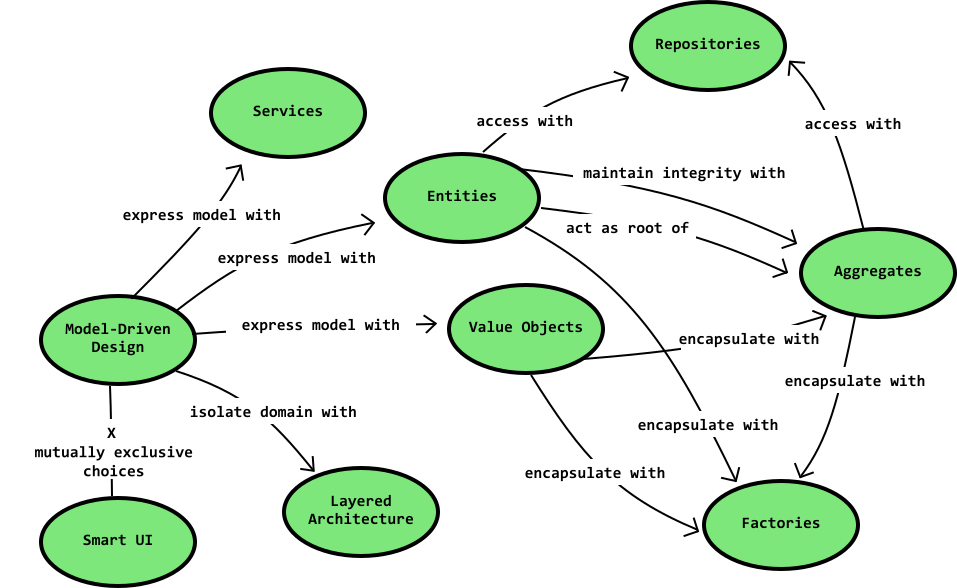
Tactical Patterns
-
Entity:
- Entities are objects that have a unique identity and represent domain concepts that change over time. They are defined by their identity, not just their attributes, and are responsible for maintaining their own state and behavior, such as a user or a product.
-
Value Object:
- Value objects are objects that have no identity of their own and are defined only by their attributes. They are immutable and can be exchanged between instances without affecting the domain logic. Examples include an address or a date. Using value objects helps to encapsulate concepts that do not require a unique identity.
-
Aggregate:
- An aggregate is a group of entities and value objects that are treated as a single unit for data consistency purposes. Each aggregate has an aggregate root that controls access to its internal members, ensuring that business rules are followed. This helps to maintain data integrity and simplify operations.
-
Repository:
- A repository is an abstraction that provides an interface for accessing and manipulating aggregates and entities. It hides the details of data persistence, allowing developers to focus on business logic. Repositories facilitate operations such as adding, fetching, and removing entities, providing an organized way to interact with the data layer.
-
Service:
- Services are used to encapsulate business logic that does not naturally fit into an entity or value object. They can perform complex operations that involve multiple entities or aggregates, such as calculations or data manipulations. Services help to keep business logic organized and isolated, promoting reusability and testability.
-
Factory:
- Factories are responsible for creating entities and aggregates, especially when the creation involves complex logic or multiple steps. They abstract the construction process, ensuring that objects are created in a valid and consistent state. Using factories helps to simplify object creation and centralize construction logic.
-
Domain Event:
- Domain events represent something that has occurred in the system and may have an impact on other parts of the application. They are used to communicate state changes and can be triggered from entities or services. Using domain events helps to maintain a reactive system and decouple components, allowing different parts of the system to react to changes efficiently.